Apprex
An invite-only real estate investment platform: premium Miami developments split into fractional shares. From investor onboarding to capital contribution, all in one place — dollar-denominated assets from small fractions.
Open apprex.io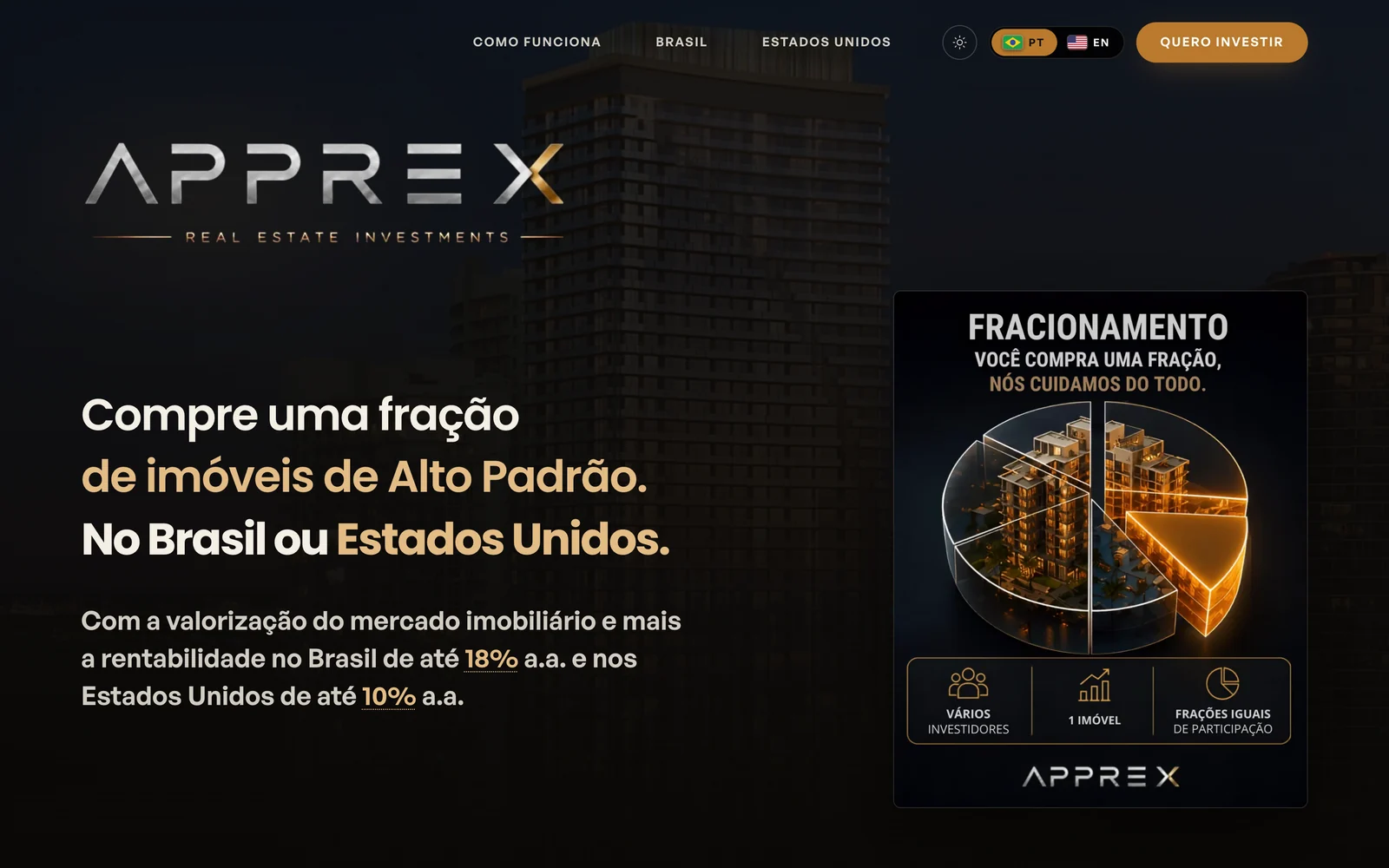
The problem
Fractional real estate is easy to describe and hard to run. The moment an asset is split between many investors, the platform stops being a catalogue and becomes a regulated financial operation: who is allowed to buy what, who actually holds a position, and how you prove either of those to an auditor a year later.
Most of the difficulty is not in the transaction. It is in eligibility — and in never being able to say "we think this is who owns it".
How it is built
The core runs in Go, chosen for throughput and predictability under financial load, organised in a hexagonal architecture: authentication, identity and source-of-funds verification, the asset catalogue, a reservation engine that expires holds automatically after 72 hours, and an immutable compliance trail where every registration step, document acceptance and eligibility decision is recorded.
Python carries the analytical layer — capital raised, sales curve, investor geography, and the reports that feed both the investor dashboard and the developer's portal. PostgreSQL holds the data, with eligibility enforced in the database itself.
Tokenisation, and who is allowed to be right
Each fraction is registered on-chain under a security-token standard, with the regulatory restrictions imposed by the contract itself: a wallet only receives if it has cleared identity verification, a transfer to a non-eligible holder is blocked at source, and lock-up periods are satisfied automatically rather than being checked by someone.
The principle organising the integration is separation of authority. The regulated infrastructure is the source of truth about ownership; Apprex is the source of truth about experience. Every position carries an external identifier and a synchronisation marker, and on any divergence the regulated source wins. The platform reads, enriches and presents — it never writes ownership.
What the developer gets
- Capital raised, tracked in real time rather than reconciled monthly.
- The conversion funnel from first visit through to contribution.
- Where investors are actually coming from, geographically.
- Sales velocity, and the construction schedule set against the funding curve.
By the numbers
- US$ 25k
- Minimum ticket
- 30–60%
- Appreciation
What sets Output Nexus apart is the method. Before producing any material, they took the care to understand the development in depth — the geography of the hillside, the concept behind the project, the professionals involved. The result is a presentation that faithfully represents what Oca built, rather than a generic adaptation of an off-the-shelf template.
Construction company · Paraíba, Brazil
Translated from Portuguese
Other work


Have something like this in mind?
Start a project